Can the Police Search Your Phone During a Stop and Search? What the Law Says.

You have probably experienced this before.
You are going about your day, chatting with friends or family, when your vehicle is stopped at a checkpoint by law enforcement officers. Nothing unusual, you think. Then things take an unexpected turn. The officers ask everyone to step out of the vehicle. They begin searching bags and personal belongings. Suddenly, an officer pulls out your laptop and asks you to unlock it. Maybe it’s your phone. Maybe it’s a tablet.
In that moment, a dozen questions run through your mind: Does this officer have the right to search my device? Am I suspected of committing a crime? Do they need a warrant? What happens if I refuse?
Confused and unsure of your rights, you wonder what the law actually permits.
If you have ever found yourself in this situation—or worried that you might—this article breaks down what Nigerian law says about stop-and-search powers and whether law enforcement officers can legally access your phone, laptop, or other digital devices.
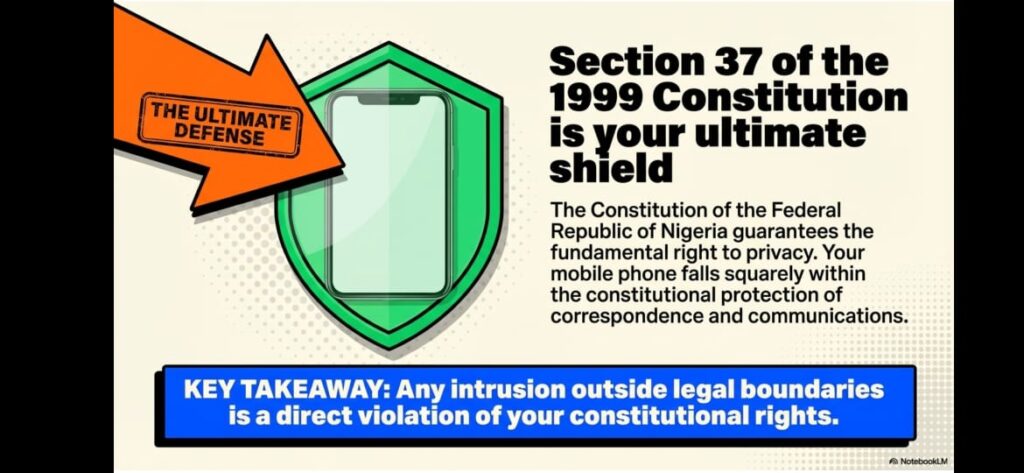
Section 37 of the 1999 Constitution of the Federal Republic of Nigeria (CFRN) guarantees the fundamental right to privacy of citizens covering their homes, correspondence, telephone conversations and other forms of communication. Therefore, mobile phones and laptops fall squarely within the constitutional protection of ‘correspondence and communications’. This provision establishes a constitutional safeguard against arbitrary intrusion into an individual’s personal life, thereby promoting dignity, autonomy and freedom of citizens within a democratic society. This right, however, is not absolute. It may be lawfully restricted in the interest of defense, public safety, public order, morality, or public health, or for the protection of the right of others.
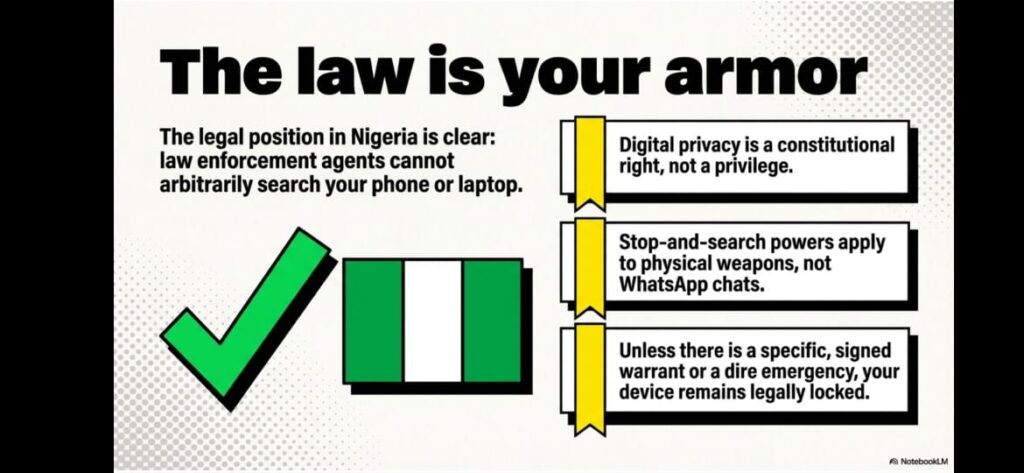
In recent times, Section 37 of the Constitution has gained increased prominence due to the rise of digital technology and data-driven interactions. Section 37 has been used to examine issues relating to data protection, cyber surveillance, and unauthorized access to electronic devices, complementing other laws like the Cybercrimes Act and Data Protection Laws in Nigeria. The Nigerian courts have also recognized digital privacy in the case of Digital Rights Lawyer Initiative v Nigerian Police Force, where the Federal High Court held that the warrantless search of citizen’s mobile phones by police officers is unconstitutional as it violates the provisions of section 37 of the Constitution.
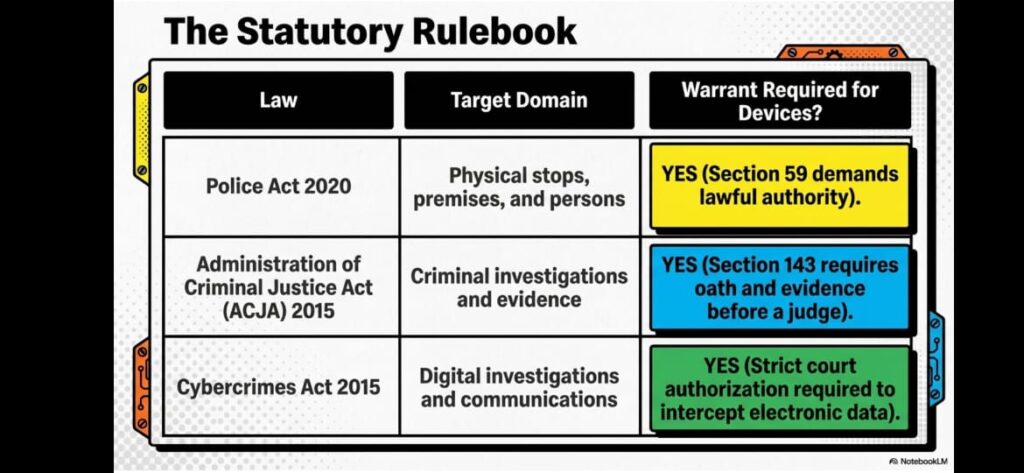
WHAT SHOULD YOU DO IF YOU ARE ASKED TO UNLOCK YOUR ELECTRONIC DEVICES DURING A STOP AND SEARCH?
- Remain calm and do not resist physically.
- Respectfully ask to see a search warrant, if they refuse and act harshly, don’t resist or talk back.
- Try to calmly elicit information about the officer’s name, station, purpose of the search etc. Take note of them and write down any helpful information immediately after the incident.
- Consult a lawyer immediately.
- Report the incident to the appropriate authorities which is the Complaint Response Unit in the Nigerian Police Force or its equivalent in other law enforcement agencies.
- File an action in Court for the enforcement of your fundamental human rights.
- Seek public accountability if necessary.
REMEDIES FOR VICTIMS OF UNLAWFUL DIGITAL SEARCH
The unlawful search or snooping of a citizen’s phone or laptop by law enforcement agents constitutes a violation of the constitutional right to privacy and attracts both judicial and administrative remedies.
In such situations, the affected individual is entitled to challenge the illegality of the search. Victims can also lodge formal complaints with the Nigerian Police Force through its Complaint Response Unit or the National Human Rights Commission, both of which are empowered to investigate allegations of abuse by law enforcement officials.
Beyond administrative complaints, the law provides robust judicial remedies through the Fundamental Rights (Enforcement Procedure) Rules 2009, which allow victims to approach the High Court for the enforcement of their fundamental human rights. The court may grant reliefs including a declaration that the search was unlawful, an award of monetary damages, an order of public apology or an injunction restraining further violation. These remedies serve not only to compensate the victims but also to promote accountability and deterrence within law enforcement agencies.